Overview
TetMesHeads is a dataset providing 516 complete tetrahedral meshes of human heads.
The creation of this dataset is a joint work between the French National Research and Safety Institute for the Prevention of Occupational accidents and Diseases (INRS) and the Goup of Research in Electrical Energy (GREEN) of University of Lorraine.
Goals & interest
Our objective is to provide high-quality meshes of human heads for use in finite element simulations. We want the corresponding dataset to be as small as possible to enable fast downloads and minimize disk space usage.
Therefore, each subject's head corresponds to a single file, allowing users to download only the files that interest them. However, if necessary, they can download the entire dataset from the repository page on data.gouv.
The samples consist of healthy adults of all ages and body types (mostly generated from the IXI dataset) and should be large enough to support potential statistical studies.
Example of use
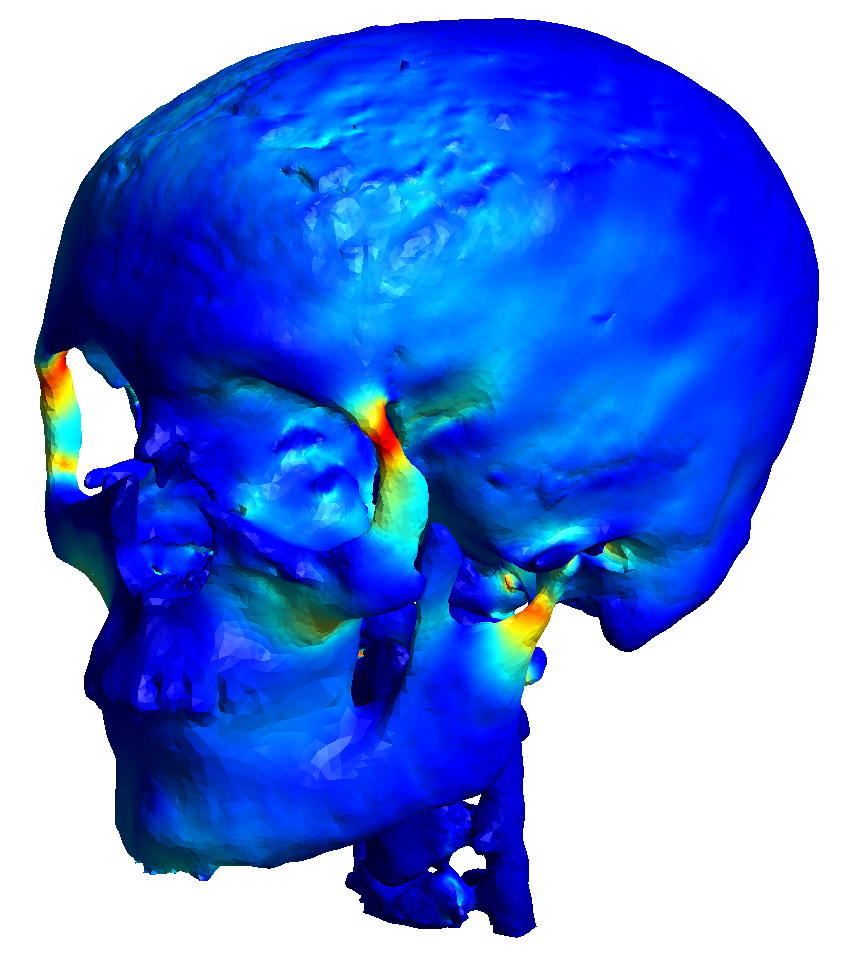
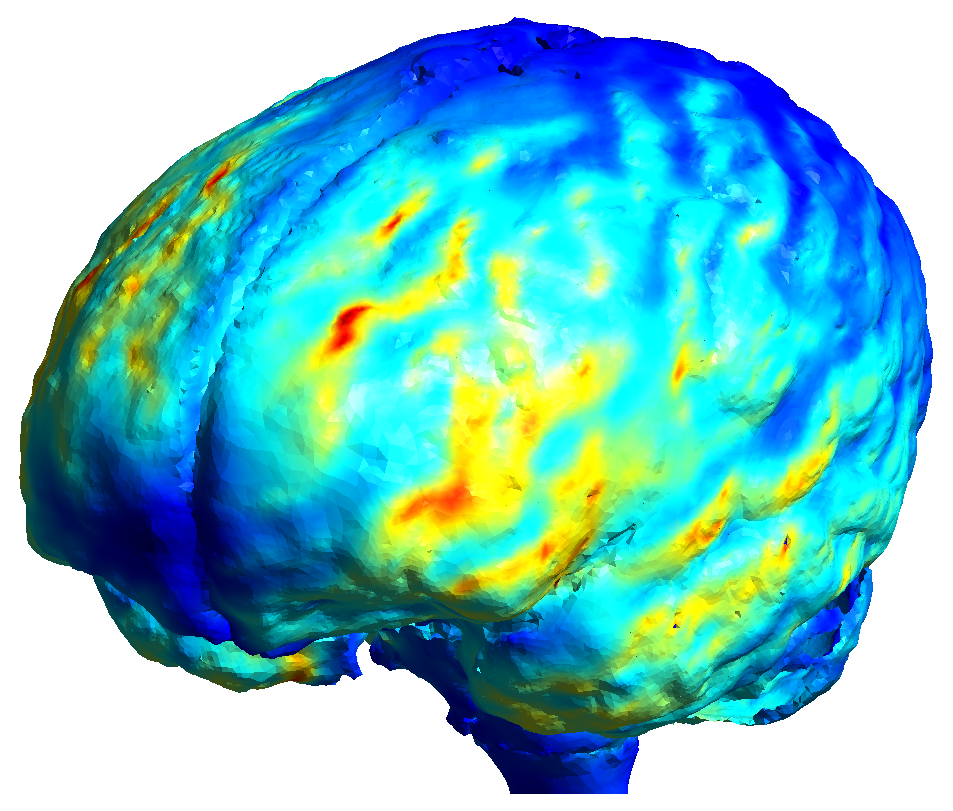
As an illustration, the figure below shows the norm of induced electric field (in compact bones) and current density (in the cerebrospinal fluid) of a worker near a power field source (inductor).
How to download files
The values provide by our dynamic table are also synthesized in this CSV file. The "file ID" in the last column permits to download each file via the command line with the following bash command (replace {file ID} with the corresponding number, and {mesh_name} with the wanted name for the downloaded archive):
1wget https://entrepot.recherche.data.gouv.fr/api/access/datafile/{file ID} -O {mesh_name}.tar.gz
License
All files in the dataset are licensed under the CC BY-SA 4.0 license.
In a nutshell, the "Reuser" is free to:
- Share — copy and redistribute the material in any medium or format for any purpose, even commercially.
- Adapt — remix, transform, and build upon the material for any purpose, even commercially.
The licensor cannot revoke these freedoms as long as you follow the license terms.
Under the following terms:
- Attribution — You must give appropriate credit, provide a link to the license, and indicate if changes were made. You may do so in any reasonable manner, but not in any way that suggests the licensor endorses you or your use.
- ShareAlike — If you remix, transform, or build upon the material, you must distribute your contributions under the same license as the original.
- No additional restrictions — You may not apply legal terms or technological measures that legally restrict others from doing anything the license permits.
➔ See Reference & credits section for details.